The U.S. Department of State (DOS) has finally released the immigration visa quotas for fiscal year 2026. Among them, the total quota for employment-based immigration has reached 186,000, with a total of 13,206 visas available in the EB-5 category.
Today, the U.S. Department of State (DOS) finally announced the immigration visa quota for fiscal year 2026. Although this announcement came a bit late, with only three months left until the end of the current fiscal year, the data is indeed surprising.
Among them, the total quota for employment-based immigration in fiscal year 2026 reached 186,000, a full 46,000 more than the regular basic quota of 140,000, with an overall increase of over 30%!
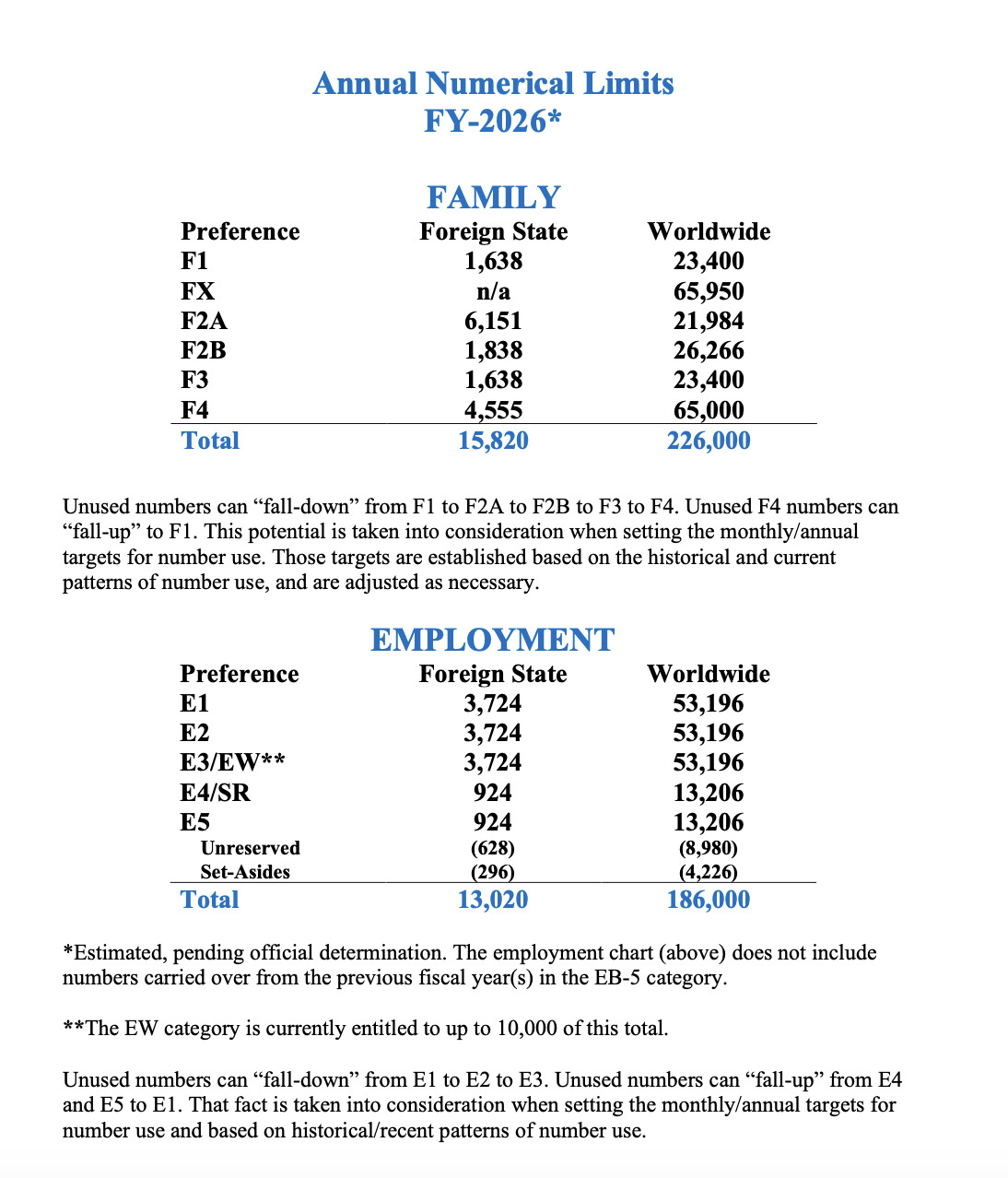 Where did the additional 46,000 quotas come from?
The answer is: it comes from the "surplus" of family immigration quotas that were not used up in the previous fiscal year.
According to the Immigration and Nationality Act (INA) of the United States, any unused quota for family-based preference immigrants in the previous fiscal year will be automatically carried over to the employment-based quota for the next fiscal year.
The core reason why this mechanism has achieved a carry-over scale of up to 46,000 this year is the Trump administration's tightening of family-based immigration policies and slowdown in processing, which have resulted in a significant amount of family-based quotas remaining unused.
What is the quota for EB-5?According to the latest published data, the total quota for EB-5 visas for fiscal year 2026 is 13,206. Among them, 8,980 are allocated for the non-reserved category and 4,226 for the reserved category.
It should be noted that the above is only the newly allocated quota for the fiscal year 2026 and does not include the visa quotas carried over from the previous year.
If the carry-over quota is included, the industry estimates that the actual available quota for investors under the old policy is approximately 9,200, while the total available quota for investors under the new policy is about 7,633 - including approximately 2,385 in high-unemployment areas, 4,771 in rural areas, and 477 in infrastructure projects. (Note: These are estimated values and are not officially announced.)
For investors in the old policy: The scheduling is expected to accelerateFor investors under the old EB-5 policy in China, this data is undoubtedly a substantial benefit. Chinese investors under the old policy are likely to receive around 6,000 quotas, nearly 1,000 more than the 5,000 received in fiscal year 2025.
This means that the backlog of cases will be processed more quickly, and the scheduling is expected to see substantial progress. For investors who have been waiting for a long time, this is undoubtedly a shot in the arm.
To investors in the New Deal: The scheduling alert has been postponed againFor investors in the new EB-5 policy, this data indicates that the fiscal year 2026 cut-off date is unlikely to occur. Industry experts generally predict that the earliest possible cut-off date under the new policy will not appear until the second quarter of fiscal year 2027.
This means that the entire fiscal year of 2026 remains in a valuable "window period without waiting list". However, it must be clearly recognized that this window is rapidly narrowing - the current volume of new policy submissions is reaching new highs every quarter.
Therefore, planning early and submitting early to secure a priority date is the wisest choice at present. The window period will not last indefinitely. Acting now is buying time for oneself.
What are the impacts on EB-1 and EB-2 applicants?
In Fiscal Year 2026, the global quota for both EB-1 and EB-2 categories was 53,196. Based on the maximum 7% per-country cap, applicants born in Chinese Mainland can obtain approximately 3,724 basic quotas for each category, which is a significant increase from the previous approximately 2,803.
However, the actual number of visas available will be far higher than this figure.
EB-1 applicants will be the biggest beneficiaries. The reason is that, except for China and India, other countries basically cannot use up their respective 7% quota in the EB-1 category. When the global quota for EB-1 increases from about 40,040 to 53,196, the net increase of about 13,000 visa quotas will actually be mainly consumed by applicants from China and India.
Therefore, it has become highly probable that China's EB-1 visa will see a significant advancement in its waiting list. The waiting lists for EB-2 and EB-3 will also move forward, but the degree of benefit is expected to be less significant than that of EB-1.
Friends who want to know more relevant information are welcome to consult Qiaowai's American immigration experts